Flowform
Geometry
There is an interesting relationship between the way water flows and the geometry inherent in natural form. One simple archetypal geometrical construction can be varied to give rise to the forms of the heart ventricles or of plant buds as well as of the spiral vortex and the form of antelope and cow horns. These are called path curve surfaces. There is always a range of possible lawful surfaces for any given parameters, and a field of formative movement is maybe a better way to describe it. In giving expression to elegant flow, one is also tuning the water towards such a field of form. Potentially one can see this could help the forming influences work into life. This is a field of ongoing research where the development of the researcher goes hand-in-hand with the development of the understanding.
The possibilities for collaborative research are being explored between researchers in different countries and institutions. These include the Foundation for Water in Sussex UK, the Natural Science Section at The Goetheanum in Switzerland , the Institute of Flow Science in Herreshried southern Germany , the Nature Institute in America and others.
A brief history of Flowforms
Flowform sculptures have arisen within collaborative work seeking to understand and reveal the essential nature of water. The designs have been developed over the last 50 years mostly by colleagues and associates of John Wilkes who was a sculptor and geometrician that discovered the possibility of engendering stable rhythmic flow while working with Theodor Schwenk at the Institute of Flow Science in Germany. The work follows a holistic approach to the natural world originally outlined by J W von Goethe called Goethean Research. This was further developed in the Spiritual Science of Rudolf Steiner and also relates to the geometry of natural form as discovered by George Adams and Olive Whicher in the middle of the 20th century.
The Flowform idea and its background
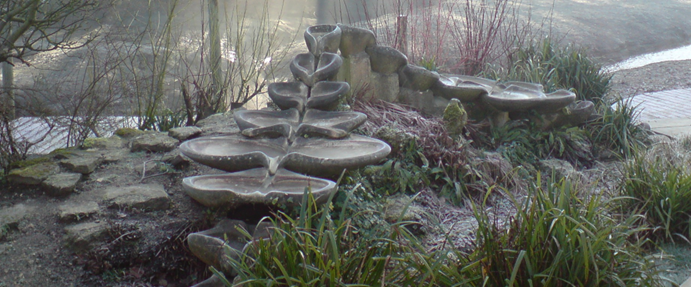
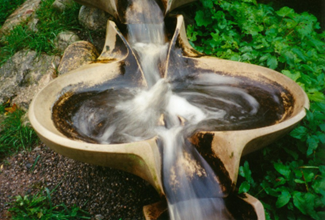
Flowforms are sculpted vessels which allow the water flowing through them to develop sustained rhythmic flow. This is not manipulated but happens purely due to the shape and its proportions.
The water enters the vessels in a steady flow and the surfaces interact with the water flow in such a way that swinging or pulsing movements arise. This process can be compared to the creation of rhythmic air movement (and hence the sound) in a wind instrument. Development of these forms often requires much experimentation to establish harmonious and lively rhythmic flows and the design of any one Flowform may take months or even years to perfect.
Many different Flowform designs have been made in order to explore expressions of rhythmic flow in water; some are very elegant and artistically satisfying sculptures, some more functional for agricultural use. What then is the significance of this rhythmic flow from a scientific perspective?
The subtle role of water in life
Many significant examples of enhanced qualities and growth in living organisms have been observed though the use of Flowforms. The laws of chemistry and physics do apply here but there are many aspects of the way living organisms grow and develop their forms which are not fully explained by these sciences.
There appear to be connections between organisms, influences from distant causes, synchronicities in plant and animal behaviour. For example, bamboo flowering events happening worldwide but 120 years apart, significant shape changes in tree buds which happen with the same frequency as planetary relationships (See Lawrence Edwards’ work in his book The Vortex of life). Synchronicities in animal behaviour have been documented in Rupert Sheldrake’s work on morphic resonance and there are thousands of documented examples of moon rhythms displayed in plant and animal life.
It can be seen that water is the sensitive mediator of these influences (maybe better called interfluences) at work in living systems. We need to shift from thinking in terms of single cause and single effect. In each organism the principles of the whole work into the parts and vice versa. The same is true for ecosystems. This role of water can be damaged in various ways, and it can be enhanced through dynamization and potentisation.
The harmonious rhythmic play in the movement of water in a Flowform is one way of enhancing this capacity of water. These improvements are not always repeated in every situation, which shows that we cannot treat nature in the same way as a machine.
But it does not negate the potential benefits from such a dynamization of the water both for the water itself and for the living environment around a Flowform cascade.
Applications
The forms have found many practical uses in agriculture and ecological work. They have been used to enhance liquid manure on farms, in compost tea production, in irrigation and in the potentization of agricultural preparations, in natural waste water cleaning systems, in baking processes, fermentation, and food handling.
Developing applications within living systems is a challenge since every form of life expresses itself differently according to context.
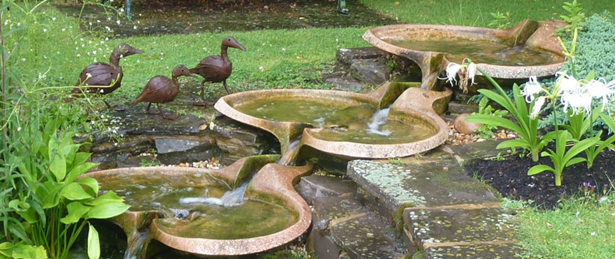
We need to think in terms of ecological wholeness – organisms rather than mechanisms. This is where a qualitative scientific approach can be very helpful and the artistic and the practical can come together. The Flowforms can be part of a respectful approach to working with nature where we work in conversation rather than directing and manipulating.
Since the initial discovery of this phenomenon in 1970 a very wide range of designs have been created. There are Flowforms with delicate water movements suitable for smaller enclosed spaces, and massive forms with very vigorous movements that can enliven large open landscapes. In some the movements are reminiscent of a heartbeat, in others of a slower ‘breathing’; some give a musical tinkling and others produce a sound more like that of waves lapping on a shoreline. These qualities have proved especially valuable in therapeutic situations and school environments.
The principles and further developments
Investigation has shown that to develop rhythm it is a question of finding a vessel of appropriate proportions for a given flow speed and with the appropriate measure of resistance. The water needs to meet itself within the form and there needs to be a suitable space to allow a dynamic movement to develop. Within the double bowl this flow can have a lemniscatory (figure of eight) path, but 3 dimensionally it is actually a play between an expansive upwelling and a contractive down-drawing gesture.
A research colleague, Dr Philip Kilner, went on to discover that rhythmic flow could also happen within a single bowl, comparable to the development of rhythmic flow in simple animal hearts and in the bloodstream of a developing embryo prior to the full formation of the heart. This discovery prompted Dr Kilner to return to the medical world where he continued to research in the realm of heart flow dynamics for many years before retiring.
Established in 1990 in Gloucestershire, UK Ebb & Flow design and make Flowforms and are developing their potential in the UK. We export and work associatively with Flowform companies in many parts of the world.

Website: ebbandflowltd.co.uk
Email: info@ebbandflowltd.co.uk
Tel: 01453 836 060
Address: Ruskin Mill, Old Bristol Road, Nailsworth, Gloucestershire GL6 0LA